
A naive analysis of Stratum V2 network traffic
2026-09-02
After the Mining Deep Dive at Casa21, I got home curious about a simple question:
If I run a Stratum V2 mining pool and connect a miner to it, can someone sitting passively on the network, looking only at the traffic in Wireshark, figure out what is happening inside the encrypted connection?
TL;DR
- Stratum V2 encrypts the protocol contents, but encryption does not make the traffic completely invisible. A passive observer can combine packet sizes, timing, direction, protocol state, and implementation details to make increasingly confident guesses about what is happening inside the connection.
- In my lab, I could infer parts of the Noise handshake, channel opening, jobs,
SetTarget, share submissions, and even correlate some events with blocks being found. - This does not mean there is a universal Stratum V2 fingerprint. These heuristics depend heavily on the network topology, proxies, implementation, and the specific behavior of the pool. My regtest setup also makes some of these inferences much easier.
- Does this mean Stratum V2 is broken? No. This is traffic analysis, not breaking the encryption.
- I also learned about the PUSH bit in TCP.
The environment
I've deployed a pool from the Stratum V2 reference implementation at commit 3f902060.
The miner is sv2-cpu-miner at commit ad03d18, configured with a single standard channel.
For this experiment, I ran both the pool and the miner on the same machine. I did this to keep the capture clean and avoid unrelated traffic in Wireshark.
I used Wireshark to capture the traffic between the pool and the miner:
                    MY MACHINE

        +-----------+                    +----------+
        |   Pool    |<=== Stratum V2 ===>│  Miner   |
        |   regtest |                    +----------+
        +-----------+                      |
              |                            |
              +----------------------------+
                           |
                    +------v------+
                    |  Wireshark  |
                    |   capture   |
                    +-------------+
This is not a typical production deployment. In a real setup, the pool and miner would usually be separated by a network, with proxies, switches, routers, and unrelated traffic between them.
This is why I call this a naive analysis. I started with the simplest possible environment to see what the packet patterns alone reveal.
The first capture
With this setup, I made the first capture before the miner could submit any shares. This gave me a clean capture of the initial connection sequence: the Noise handshake, followed by the Stratum V2 protocol setup, including SetupConnection, OpenStandardMiningChannel, and so on.
The first four packets were the TCP three-way handshake plus a TCP Window Update. This is TCP behavior, not Stratum V2 behavior, as the Wireshark output shows:
-[SYN] Seq=0 Win=65535 Len=0 MSS=16344 WS=64 TSval=2712331854 TSecr=0 SACK_PERM

- [SYN, ACK] Seq=0 Ack=1 Win=65535 Len=0 MSS=16344 WS=64 TSval=3769171412 TSecr=2712331854 SACK_PERM

- 59207 → 3333 [ACK] Seq=1 Ack=1 Win=408320 Len=0 TSval=2712331854 TSecr=3769171412

- [TCP Window Update] [ACK] Seq=1 Ack=1 Win=408320 Len=0 TSval=3769171412 TSecr=2712331854
Now, when looking at the packets in this same stream initiated by the handshake above, we can notice the first obvious and expected thing: the data is encrypted.
[PSH, ACK] Seq=1 Ack=1 Win=408320 Len=64 TSval=2712331855 TSecr=3769171412

0000   02 00 00 00 45 00 00 74 00 00 40 00 40 06 00 00   ....E..t..@.@...
0010   7f 00 00 01 7f 00 00 01 e7 47 0d 05 a9 69 ff c7   .........G...i..
0020   1f 75 b8 43 80 18 18 ec fe 68 00 00 01 01 08 0a   .u.C.....h......
0030   a1 aa e6 4f e0 a8 fd d4 4e b9 fa 7b 8a 8a b8 95   ...O....N..{....
0040   67 1f 11 67 05 94 b0 e0 93 47 89 b5 1e 2f f6 78   g..g.....G.../.x
0050   95 9e 87 06 94 b4 bc a0 42 9a 01 26 0c 01 73 5c   ........B..&..s\
0060   71 1f 55 42 d0 15 d0 8b ad b0 eb 5b 7c cc cb ac   q.UB.......[|...
0070   6d 20 a3 b6 1d f2 a1 3c                           m .....<
This is an improvement over Stratum V1 packets, whose contents were unencrypted JSON. For example, this packet exposes its contents:
0000   02 00 00 00 45 00 00 7a 00 00 40 00 40 06 00 00   ....E..z..@.@...
0010   7f 00 00 01 7f 00 00 01 f6 0e 85 cf 1d d4 5b b9   ..............[.
0020   85 21 a9 f7 80 18 18 ec fe 6e 00 00 01 01 08 0a   .!.......n......
0030   18 8a ed 63 ac 07 b9 6c 7b 22 69 64 22 3a 20 31   ...c...l{"id": 1
0040   2c 20 22 6d 65 74 68 6f 64 22 3a 20 22 6d 69 6e   , "method": "min
0050   69 6e 67 2e 73 75 62 73 63 72 69 62 65 22 2c 20   ing.subscribe",
0060   22 70 61 72 61 6d 73 22 3a 20 5b 22 63 70 75 6d   "params": ["cpum
0070   69 6e 65 72 2f 32 2e 35 2e 31 22 5d 7d 0a         iner/2.5.1"]}.
PSH what?
When looking at the Stratum V2 packets, the first thing that caught my eye was: what the hell is this PSH thing?
After a quick look at TCP RFC 9293, I found that PSH is one of the TCP control bits:
Flags: 0x018 (PSH, ACK)
    000. .... .... = Reserved: Not set
    ...0 .... .... = Accurate ECN: Not set
    .... 0... .... = Congestion Window Reduced: Not set
    .... .0.. .... = ECN-Echo: Not set
    .... ..0. .... = Urgent: Not set
    .... ...1 .... = Acknowledgment: Set
    .... .... 1... = Push: Set                      <<<<< right here
    .... .... .0.. = Reset: Not set
    .... .... ..0. = Syn: Not set
    .... .... ...0 = Fin: Not set
    [TCP Flags: ·······AP···]
Normally, TCP is allowed to buffer data before sending it. The PSH bit is related to the TCP stack's handling of that data and indicates that the receiving side should make the data available to the application promptly rather than waiting for additional data.
The important detail here is that the application does not directly set the PSH bit in the TCP header. The TCP implementation, usually the kernel's TCP stack, decides how to packetize the data and whether to set the bit. The way the application writes data to the socket can influence what the TCP stack does, but the actual bit in the packet is set by the TCP stack.
Also, PSH is not a message boundary. TCP is still a byte-stream protocol, so we cannot look at a PSH bit and say "this is where the Stratum V2 message ends." It is simply a TCP-level indication associated with the data being transmitted.
So, seeing [PSH, ACK] in these packets does not mean that Stratum V2 itself is doing something special. It is behavior of the underlying TCP connection.
Things we can infer from the packets, with some cheating
When I started this experiment, I expected packet lengths to reveal some message flows. A passive observer who does not know which traffic to inspect may not get much from that alone. So I decided to cheat a little.
I matched the packet lengths with message lengths from the publicly available Stratum V2 specification, using commit 0f38d51.
This lets us infer when the first two acts of the Noise protocol occurred.
The Noise dance
After the start of the pool, the initiator, in this case the CPU miner, sent an IP packet sized 120 bytes. If we strip the IP and TCP headers, we are left with only 64 bytes of TCP payload in the packet:
59207 → 3333 [PSH, ACK] Seq=1 Ack=1 Win=408320 Len=64 TSval=2712331855 TSecr=3769171412

Data (64 bytes)
    data: 4eb9fa7b8a8ab895671f11670594b0e0934789b51e2ff678959e870694b4bca0429a01260c01735c711f5542d015d08badb0eb5b7ccccbac6d20a3b61df2a13c
    [length: 64]
From this, I can make the following guess:
- I know Stratum V2 uses Noise encrypted connections.
- Looking at the spec, we can see that the initial message is also 64 bytes in section 4.5.1.1:
field name description pubkey initiator's ephemeral public key message length: 64 bytes
And the exact message that comes after this is a 234-byte data message, sent shortly after:
[PSH, ACK] Seq=1 Ack=65 Win=408256 Len=234 TSval=3769171415 TSecr=2712331855

Data (234 bytes)
    data […]: 467ee58ba78ead3b13b0eecea585e6115501840ef74fa143c85b34155458958ba329490836820cb124f60e20cb05334dbc166d8ae678811ec7994b29cceccb98abe41f33b8a42abfbf5db52b64ccdc5f03759805dc9e2a46a86f60a169a0935dc56b0cb877760b55d0184c4611b72393de4
    [length: 234]
At the time of writing, the Noise handshake in the Stratum V2 specification contains no 234-byte message. That would break this heuristic.
However, section 4.5.2.1 says that act 2 has 170 bytes. The capture shows 234 bytes. I opened issue #215 to report the discrepancy. For now, I am treating the capture as the correct value.
An observer who matches this traffic against the specification can make a better guess about what is happening in the connection. Packet sizes and the time between them can provide reasonable confidence that the packets correspond to specific parts of the Noise handshake, even without decrypting their contents.
The Stratum V2 dance
The Noise handshake is followed by a burst of messages. This matters because a miner has no reason to open a connection, complete the Noise handshake, and then wait before opening mining channels. It wants to start hashing as soon as possible.
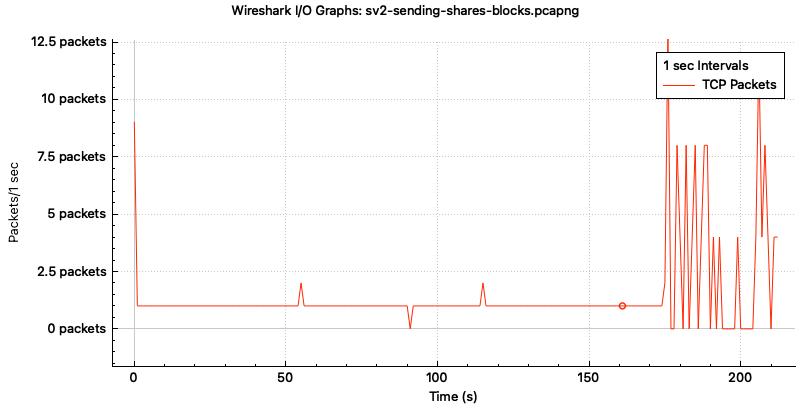
The Noise handshake is followed by the Stratum V2 handshake. In the plot below, Wireshark shows nine data-carrying packets in the first second, excluding the TCP handshake and ACK-only packets. These are our Stratum V2 message candidates.
A packet does not necessarily represent one protocol message. A large message can split across several packets. In my lab, each packet happened to contain one complete message, but that was a coincidence:
From here, things start to become a little trickier because the initial Stratum V2 messages can have different sizes. If we look at the SetupConnection definition, we can see that besides the fixed-size fields like protocol (U8), versions (U16), etc., we also have fields with the datatype STR0_255. By the spec definition, these can go from 0 to 255 bytes of actual string data, depending on what is being sent inside them. Since the type also has a one-byte length prefix, its minimum encoded size is 1 byte.
So one heuristic here is that we could take all the fixed-size fields and assume the dynamic-sized strings have a length of zero. This gives us the minimum packet data size for SetupConnection.
As we calculated before, we have a minimum of 16 bytes for the SetupConnection payload. Adding the 6-byte Stratum V2 frame header and the Noise MAC overhead described in the security section of the SV2 spec gives us a minimum theoretical encrypted packet size of 54 bytes.
But besides that, we know that the response to these initial messages can have a fixed size.
SetupConnection.Success has a fixed-size payload of 6 bytes. If we apply the same process we mentioned before, adding the SV2 frame header and the Noise MACs, we always get a fixed response size of 44 bytes if the SetupConnection succeeds.
Another thing we know is that the first Stratum V2 message is always sent by the Client, and that message is SetupConnection. So another heuristic could be to look for a data-carrying TCP segment with a minimum payload size of 54 bytes, followed shortly after by a possible response with a 44-byte payload.
If we see this pattern, we can make a fairly educated guess that we are looking at the SetupConnection process, even though we cannot see the contents of the messages themselves.
We could apply the same heuristic to the protocol's other messages and responses. I will stop here because the pattern is clear and I got lazy.
At this point, the inferences look like this:
| Observed traffic | Likely message | Why |
|---|---|---|
| Client -> Server, 64-byte TCP payload | Noise Act 1 | Matches the expected 64-byte initial Noise message |
| Server -> Client, 234-byte TCP payload | Noise Act 2 | Matches the observed implementation behavior and follows Act 1 |
| Client -> Server, ≥54-byte TCP payload | SetupConnection candidate | Minimum encrypted size based on the message fields + framing + Noise overhead |
| Server -> Client, 44-byte TCP payload | SetupConnection.Success candidate | Fixed-size response |
| Server -> Client, 74-byte TCP payload | SetTarget candidate | Matches message size, direction, protocol state, and timing |
| Server -> Client, 87-byte TCP payload | NewMiningJob candidate | Fits the protocol state and message sequence |
| Client -> Server, 62-byte TCP payload | SubmitShares.Standard candidate | Matches message size, direction, and protocol state |
| Server -> Client, 58-byte TCP payload | SubmitShares.Success candidate | Matches message size, direction, and expected response |
None of these means that "packet size X proves message Y." They become useful when we combine size, direction, timing, sequence, and protocol state.
Shortly after an Open Channel message, if it succeeds, the Server sends 3 consecutive messages. One of them is fingerprintable because, in all the captures I have, it has the same 103 bytes of data. Following the logic of the protocol and the size of the OpenStandardMiningChannel.Success message, I can make a pretty good guess about what this message is. The next two messages can also be deduced from the state machine, since at this point we already know what the Server is expected to send after successfully opening the channel.
After that initial burst of messages (see the "Wireshark Packet Burst Plot" image), I captured a sequence of several fixed-size messages.
A few more inferences:
After these Open Channel inferences, my capture registered several packets with a TCP payload of 87 bytes, interleaved with packets with a payload of 74 bytes.
Looking at the spec, we can match the 74-byte packets with the SetTarget message. But this inference does not come from packet size alone. It also depends on an implementation detail of the SRI Pool.
The vardiff mechanism in the SRI Pool sends a new SetTarget every 60 seconds, when needed. Each of these 74-byte packets appears approximately every 60 seconds in my capture, which makes the inference much stronger.
See the Delta Timing of each 74-byte message:
| Delta  |  SRC - DST  | Info
55.550915 3333 → 59207 [PSH, ACK] Seq=5336 Ack=219 Win=408128 Len=74 TSval=3769226963 TSecr=2712386684
59.999798 3333 → 59207 [PSH, ACK] Seq=10630 Ack=219 Win=408128 Len=74 TSval=3769286963 TSecr=2712446970
59.999831 3333 → 59207 [PSH, ACK] Seq=15924 Ack=219 Win=408128 Len=74 TSval=3769346963 TSecr=2712507250
Since this is a recently established connection, the protocol state also makes me think that the 87-byte packets are likely NewMiningJob messages.
The 60-second SetTarget frequency is not a protocol requirement. It comes from the SRI Pool's vardiff mechanism, so this heuristic may not work with another pool implementation.
Message direction is another useful clue. This sequence goes from the Pool to the Client, and the specification defines both NewMiningJob and SetTarget as Server -> Client messages.
So at this point, the heuristic is no longer simply:
"I saw a packet with X bytes, therefore it must be message Y."
It is more like:
"I saw a packet with X bytes, going in this direction, at this point in the protocol state, followed by this other packet with Y bytes, and it repeats with the timing expected from this particular implementation."
Combining these observations increases our confidence about what is happening inside the encrypted Stratum V2 connection.
Inferring share rate and block events
I cannot determine the miner's hashrate because the relevant data is encrypted. After the sequence of NewMiningJob and SetTarget messages, however, the miner was probably receiving jobs that allowed it to submit shares upstream.
Looking at the capture file, I now see, until the end of the capture, a sequence of message sizes in bytes like [62, 58, 83, 86, ...], which then repeats.
My lab is running on regtest, where finding a block is easy. This matters for the next inference.
The first two packets, the ones with sizes 62 and 58, can be identified from the previous heuristics as SubmitShares.Standard and SubmitShares.Success.
This guess does not come only from the packet sizes. Both messages have a fixed size, but the state machine of the protocol also gives us a hint about what messages should come next.
I can cheat a little more here. An observer could run a Bitcoin Core node and compare the arrival times of these SubmitShares.Success responses with blocks found by that node on the same network.
If we match the arrival time of the 58-byte message with the UpdateTip entries in the node's log, we can see that this happened right after a block was found.
For example:
UTC Time of the Arrival of the Packet:
2026-09-01T22:40:57.375345000Z 3333 → 59207 [PSH, ACK] Seq=22441 Ack=2017 Win=408128 Len=58 TSval=3769383801 TSecr=2712544243

Node Log:
2026-09-01T22:40:57Z UpdateTip: new best=000074a736487d08052330f34f118fa50859c6b8d3d585145a433c399087d3c7 height=29 version=0x20000000 log2_work=5.906891 tx=30 date='2026-09-01T22:40:56Z' progress=1.000000 cache=0.3MiB(29txo)
The next two messages, with sizes 83 and 86 bytes, also make sense from the logical consequences of the protocol. They are a future NewMiningJob followed by a SetNewPrevHash activating that job.
Remember when I told you that my lab is running on regtest? Now this comes into play.
On regtest, the difficulty is extremely low compared with mainnet. In this experiment, a submitted share can also satisfy the block target, which lets us correlate share submissions with blocks being found.
In a more realistic scenario, however, things are not that simple. SubmitShares.Success is a response to submitted shares, and the pool can choose how it batches and validates them. For example, an implementation could send one SubmitShares.Success after every 10 successfully validated shares.
The correlation between every SubmitShares.Success and a block being found would therefore not be a strong relation on mainnet either. A NewMiningJob followed by a SetNewPrevHash could simply mean that some other miner or pool found a block.
One case where I think we could make a stronger inference is if the observer first learns the pool's normal SubmitShares.Success pattern. Let's say the observer notices that the pool normally sends one SubmitShares.Success for every group of 10 shares.
Later, the observer sees a SubmitShares.Success after only 3 shares. This could be an indication that the pool found a block and responded to that connection immediately instead of waiting for the normal batch.
But again, this is not behavior imposed by the protocol. It would only be an implementation detail of that particular pool. The pool could continue using the same batching logic even after a block is found.
The share submission messages also reveal the share rate. This is not the hashrate. The payload encrypts the hashrate information.
We could look at the share-submission packets for each TCP connection to the pool and make a simple calculation based on the number of packets captured over a given period.
This estimate becomes less useful over time because of vardiff. As the difficulty adjusts, connections tend to converge toward a similar share-per-minute rate. A long enough capture could still reveal a large increase or decrease in a miner's activity.
Conclusions
- To an observer who does not know what to look for, this encrypted traffic may not draw much attention among other network traffic. It did not stand out to me before I understood the protocol.
- An observer who knows the protocol could identify likely Stratum V2 traffic with some confidence. Someone monitoring network traffic could use this information to identify or block suspected mining operations.
- Does this mean that Stratum V2 is broken? No. Preventing traffic fingerprinting is not one of the protocol's main goals. The protocol aims to support a more decentralized approach to template creation and mining.
- This scenario is also naive. Real traffic would be harder to analyze because of network noise and mining proxies that aggregate multiple miners behind one connection to the pool.
- Implementations can behave differently. For example, the Translator Proxy created by the SRI team opens a Mining Channel with the pool only when the first mining device connects to it. This breaks my earlier assumption about the initial packet burst. With the Translator Proxy, we could see the Noise handshake and the Stratum V2
SetupConnectionhandshake without seeing an immediate Open Channel message.
I did not try several things. I used one miner, one pool, one connection, and a known implementation on both sides. I did not build a classifier, test multiple implementations, add realistic network noise, or test these heuristics through different proxy configurations.
That was not the point of this experiment.
I wanted to know whether I could inspect an encrypted Stratum V2 connection in Wireshark and still determine what was happening.
In this lab, I could.
If you want to reproduce the experiment or play around with the capture yourself, you can download the packet capture here.